
How long did your last grant application take?
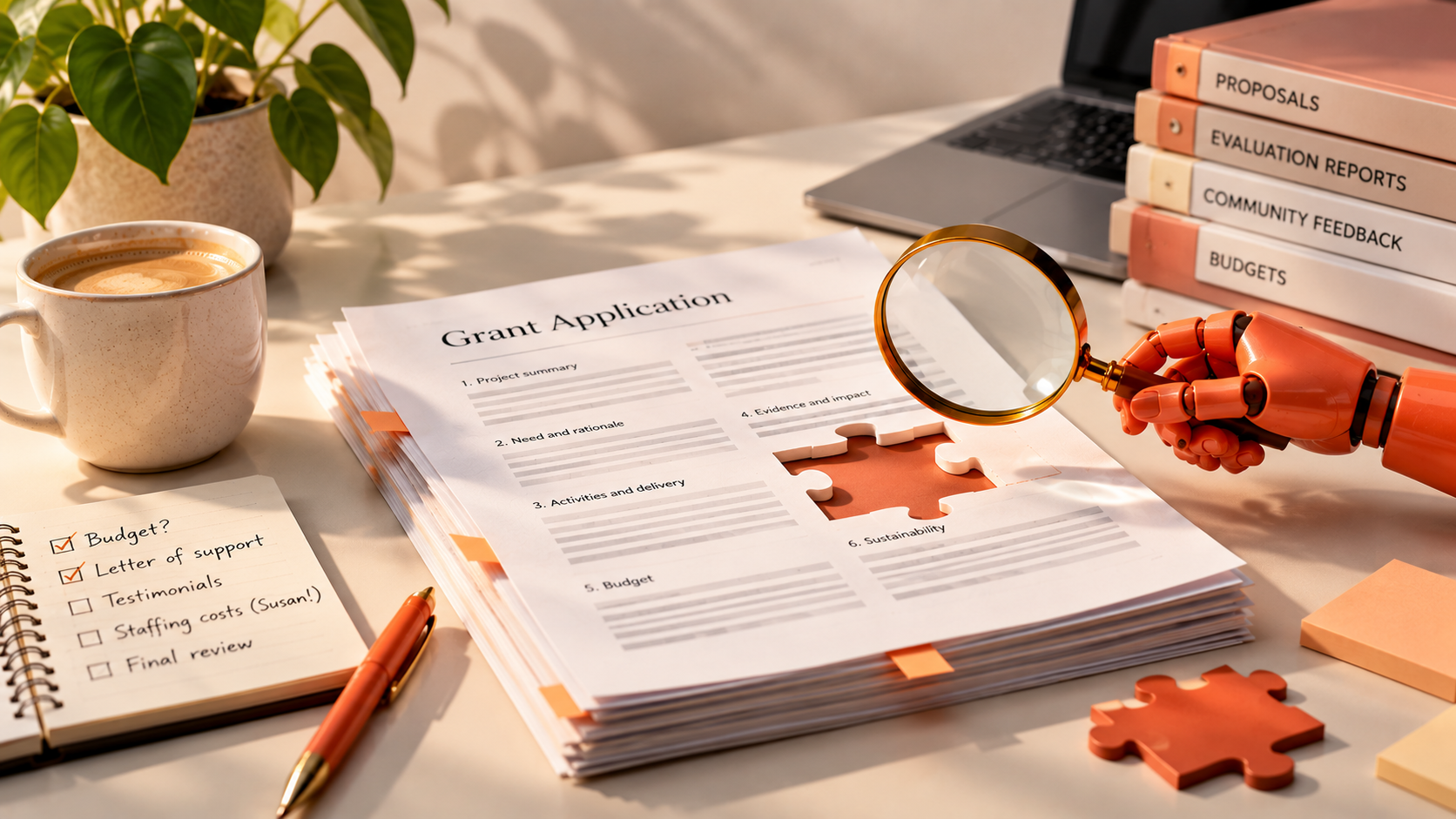
Now include chasing Susan for staffing costs, reminding a partner about their letter of support and finding the client testimonial in an email helpfully titled “Re: Re: Tuesday”.
In my experience, an application can still take 8–15 hours, even with AI help. Writing is only part of it. You’re also working out what you’re proposing, why it’s needed and whether you can deliver it.
I’ll wait while you pour yourself a coffee. Or something stronger.
Checking evidence, costs and delivery strengthens your case in a competitive field. As an example, for lululemon’s 2026 Community Wellbeing Grant, nearly 3,000 organisations applied and 80 received funding. Roughly 3%. Clear writing needs a well-supported project behind it.
Before just copying the grant questions into AI, ask it to help you find what you haven’t thought through.
Your organisation probably knows more than your draft suggests
Useful evidence is often scattered across documents. In a January 2026 TechSoup article, Phil Ferrante-Roseberry describes using Microsoft 365 Copilot to draw on emails and previous proposals his account can access. Copilot can retrieve earlier concept notes, connecting past work with new opportunities. He then asks follow-up questions about potential funders, their initiatives and their grantmaking history.
Start with documents relevant to one application.
Suppose you’re seeking funding for children’s sports registration fees. Gather the criteria, project outline, reports and anonymised family feedback. Use an AI tool approved for those documents. Ask:
“Which evidence supports our proposal? Point me to the source, identify gaps and separate evidence from assumptions.”
Perhaps last year’s evaluation explains why children stopped attending. The report someone spent weeks producing is about to enjoy a second career.
Give AI permission to question the idea
If that evaluation mentions barriers beyond cost, paying fees may only solve part of the problem.
Now ask:
“What are we assuming about how paying fees leads to regular participation? What should we check with families?”
AI might suggest transport or equipment. Treat these as questions to investigate.
If families confirm transport is a problem, explore budget scenarios:
“Using these costs, compare supporting 20 children with fees alone against supporting fewer children with fees and transport. What are the trade-offs?”
Now you are actually developing the project. Twenty registrations look good on paper. Less so if the children can’t get to training. Unfortunately, “removing barriers to participation” doesn’t come with a minibus.
A confident paragraph can still have a hole in it
Adding transport and reducing participant numbers means updating the budget, activities and outcomes. It’s easy to change the plan and leave the original promise in paragraph three.
Once you’ve drafted the application, review it against the criteria:
“Compare the draft, budget and delivery plan. Flag inconsistent numbers, unfunded activities and outcomes we haven’t explained. Show me the relevant passages.”
Check the findings against your documents; AI can misread them. Ask a colleague whether the proposal is deliverable, before promising to change the world with one part-time coordinator and a minibus booked on Thursdays.
Build skills you can use again
Using AI effectively takes practice: choosing information, asking follow-up questions and challenging answers.
